
The Old Guard vs. The Hype: Choosing Your Stack Without Falling into the Overengineering Trap
Note for Devs: This text isn't about which technology is "better." It's about how managers and CTOs think when choosing a stack. Understanding this logic helps you defend your technical choices with arguments they understand — and avoid frustration when the decision isn't what you wanted.
In software development, the only constant is change. But there's an eternal tension for those making technical decisions: on one side, the stability of technologies that have "paid the bills" for decades; on the other, the seductive shine of new frameworks that promise to reinvent the wheel every six months.
For managers and CTOs, this is a minefield. The answer to not blowing the budget (and the team's sanity) isn't found in the absolute "best technology," but in the technology suited to the size of the problem.
Let's analyze the landscape by dividing the world into two hemispheres: the Robustness of PHP and the Frenetic Innovation of Node.js, using vehicle analogies to ensure you don't hire a Formula 1 crew just to deliver pizza.
Note: The following comparisons are based on practical purpose and usage profile, not architectural equivalence between technologies.
1. The PHP World: The "War Veteran" (Diesel and Reliability)
PHP is like that diesel engine that never breaks down. It may not be the "sexiest" thing in the world and gets side-eye from purists, but it's present in approximately 77% of websites with identifiable server-side language, according to W3Techs. It represents stability, cheap hosting, and the ability to "get the job done."
The "Heavy-Duty Bicycle" Stack: WordPress or Pure PHP
- What it is: Classic development. The server delivers ready-made HTML. No complex build steps, no node_modules weighing 1GB.
- Use Case: Institutional websites, blogs, small e-commerces, rapid validation MVPs.
- The Advantage: Unbeatable cost. Any $3 shared hosting runs this. If the server goes down, it comes back up on its own. Near-zero maintenance.
The "Executive Sedan" Stack: Laravel
- What it is: The Honda Accord of the web. It's PHP, but wearing a suit. Laravel professionalized the language, bringing elegant architecture, robust security, and an ecosystem where everything comes ready out of the box (queues, authentication, payments).
- Use Case: Serious startups, ERP systems, SaaS platforms that need financial stability and long-term viability.
- Why choose it: Extreme productivity. You don't waste time configuring libraries ("reinventing the wheel"); you focus on business logic. It's the safe choice for those who want to sleep soundly.
2. The Node.js World: The "Hype" (Electric and Modular)
This is where the magic (and chaos) happens. The JavaScript ecosystem is fast, modern, asynchronous, and allows using the same language on Front and Back end. It's the "trendy" choice, but a trend with V8 engine power.
The "Electric Skateboard" Stack: Express (with EJS/Pug)
- What it is: Radical minimalism. You spin up a server in 10 lines of code. It's flexible, lightweight, but "bare."
- Use Case: Simple microservices, quick APIs, hackathon prototypes.
- The Risk: Because it's so loose, each developer writes code their own way. Without strict discipline, it becomes "spaghetti code" very quickly.
The "Tesla Model S" Stack: Next.js (React) or Nuxt (Vue)
- What it is: The current market king among full-stack meta-frameworks. It combines server-side rendering (SSR) with application interactivity (SPA). It's fast, Google-indexable, and offers a futuristic user experience (UX).
- Use Case: Content portals, high-performance e-commerces, interactive dashboards.
- The Advantage: It's the technology that attracts talent. Developers love it, investors like hearing the name, and the performance is cutting-edge.
The "Armored SUV" Stack: NestJS
- What it is: The attempt to bring order to the Node house. NestJS enforces a modular, typed (TypeScript), and organized architecture, very similar to Java or C#.
- Use Case: Large corporate applications that require Node.js but can't afford disorganization.
- Why choose it: It brings the structure and security of the corporate world to JavaScript's speed.
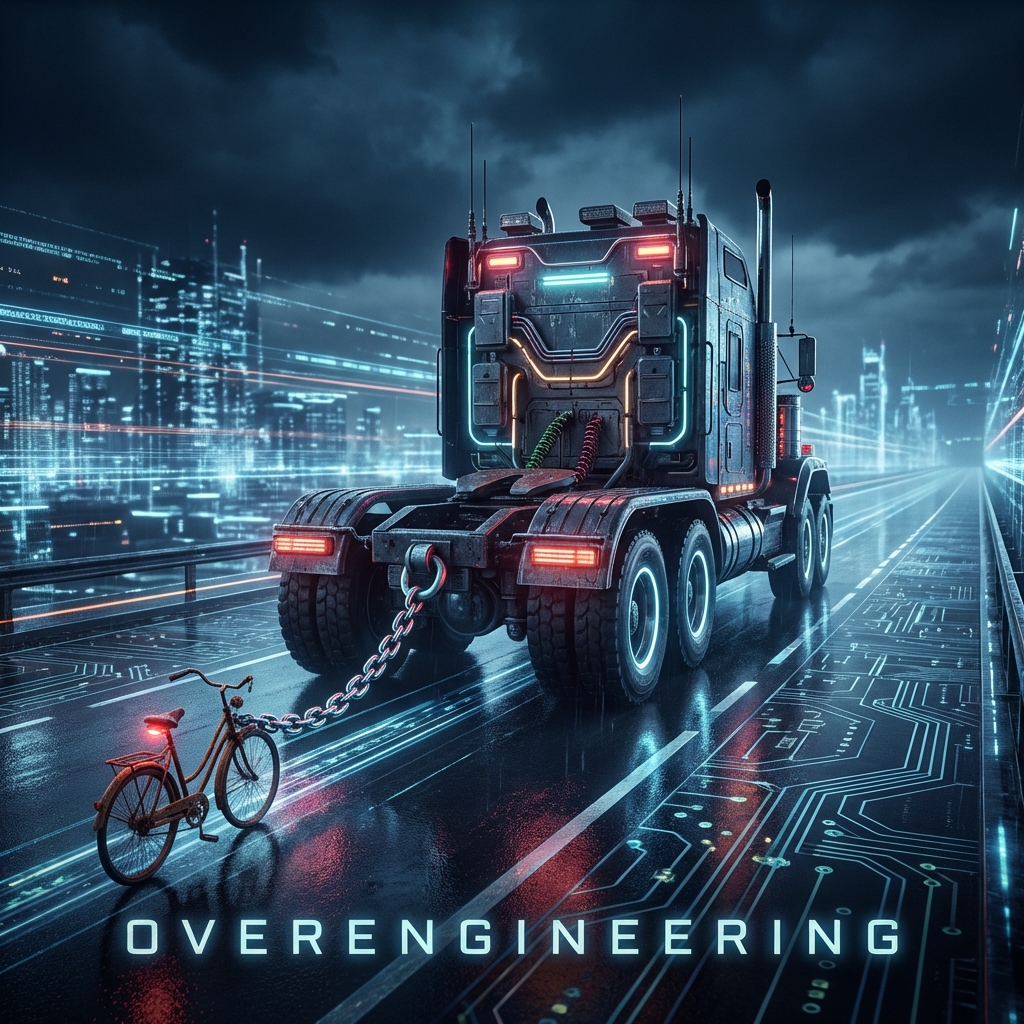
3. The Complexity Trap: The "18-Wheeler Truck" Stack
Regardless of whether you choose PHP's security or Node's modernity, there's an abyss where many projects fall: Overengineering.
This happens when we use tools designed for Google or Netflix on projects that don't have their problems. We're talking about premature Microservices, unnecessary Kubernetes, GraphQL for everything, and event-driven architectures (Kafka) for simple systems.
The Trailer Problem
Imagine you need to take your bicycle to the repair shop. Would you hire an 18-wheeler truck for that transport?
It sounds absurd, but that's what happens when a company fragments its system into 15 different microservices to process 50 orders per day.
The cost isn't just in the code, it's in the friction:
- Changing a database field requires altering 4 repositories.
- Doing a deploy takes 30 minutes instead of 2.
- The team spends more time configuring AWS than creating features for the user.
The Mechanic Test:
If you hire a Ferrari (or a Truck), you need specialized mechanics. Ask yourself:
- Does your team know how to debug a race condition between three different services?
- Do they have the bandwidth to manage message queues that fail silently at 3 AM?
The Logical Decision:
If the answer is NO, avoid the fatigue. Stick with the Modular Monolith (The Sedan).
It's much smarter to have a well-organized system in one place (whether in Laravel or NestJS), where it's easy to find and fix bugs, than to try managing distributed chaos that your team doesn't master.
Conscious Software Engineering
The best stack isn't the one in the Trending Topics, but the one that solves the business problem with the lowest possible maintenance cost.
In engineering, simplicity isn't regression; it's the highest degree of sophistication.
What Does This Mean For You, Dev?
- If the project uses PHP and you wanted Node: it probably wasn't ignorance. It was basic math.
- If you want to propose a stack change: present it in terms of cost, risk, and time, not "it's more modern."
- If you master "less hyped" technologies: that's an asset, not a flaw. Companies need people who deliver, not people who experiment in production.
The best way to gain technical autonomy is to first prove that you understand the business problem.
Tools Mentioned:
- PHP World: PHP | Laravel | WordPress
- Node World: Node.js | Express | Next.js | NestJS
- Infra (Use sparingly): Kubernetes | Kafka | GraphQL
Research References: